A New Standard of the Azawakh
In early 2009, I worked with Brian Reiter to draft a new Standard of the Azawakh. It is based on field research by the Association Burkinabe Idi du Sahel and others and is descriptive of the natural breed in the vein of the Saluki standard.
HISTORY
The Azawakh serves three distinct yet inextricably inter-related functions for the peoples of Africa’s Sahel and Southern Sahara: guardian, hunter and status symbol. Its morphology has been shaped both by the aesthetic criteria of Sahelian cultures and the harsh environment in which it has been isolated for thousands of years.
GENERAL APPEARANCE
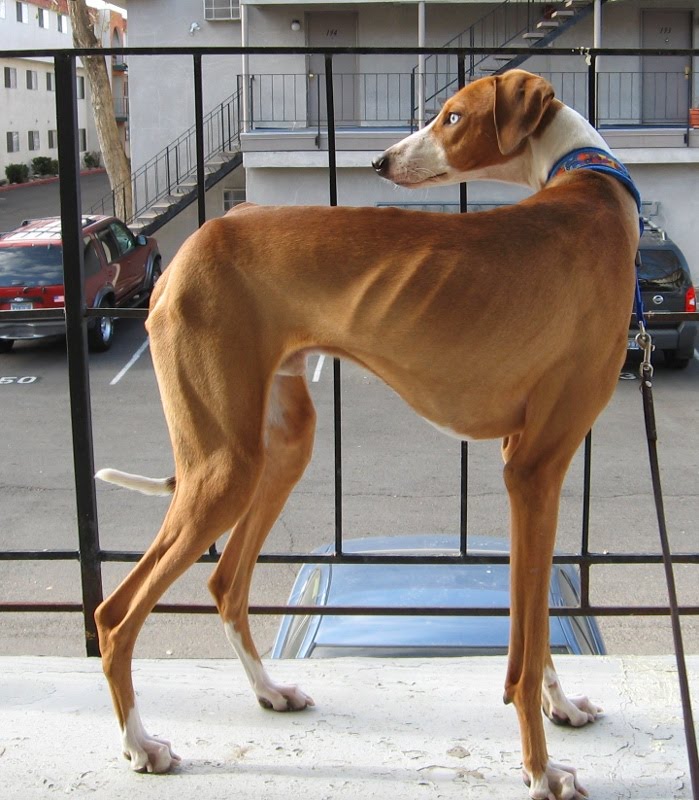
With a skeletal structure that is distinguished by straight, architectural lines and extremely open angles of the joints, the Azawakh gives an overall impression that is sere and harmonious. The Azawakh appears tall as a direct result of having long legs and a relatively short back; however it is a medium-sized hound with typical heights ranging from 22 to 28 inches (55 to 71 cm) at the withers and weights from 30 to 55 pounds (13.5 to 25 kg).
HEAT TOLERANCE
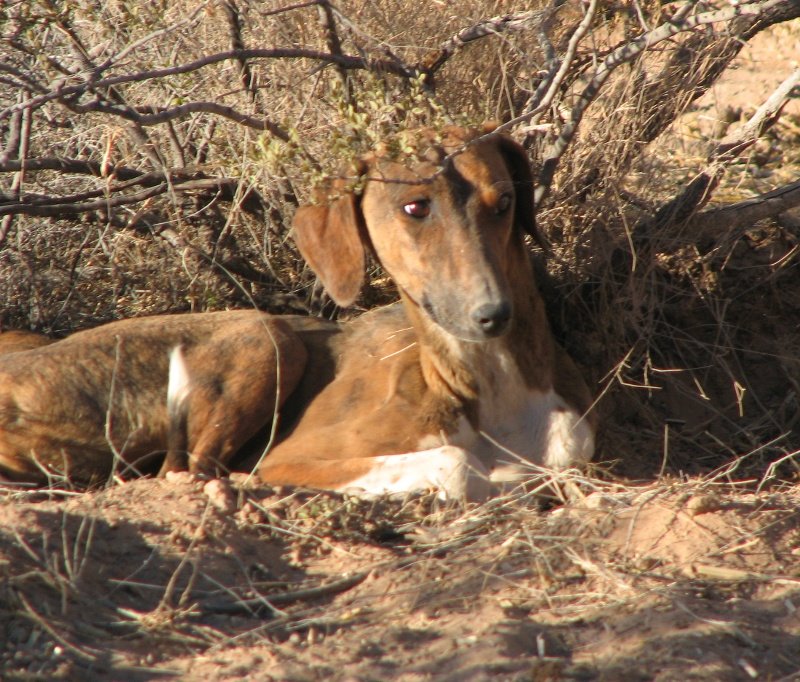
The Azawakh is superbly adapted morphologically to withstand the intense heat of the desert. Its muscles are dry, flat and attached obliquely to the bone for maximum cooling surface area. Its skin is fine and highly vascular, functioning as a radiator cooling the blood. Its hair is short, its body devoid of excess fat. Overall morphology, economy of motion and an ability to efficiently radiate accumulated heat provides for a dog with both speed and great endurance. An Azawakh is able to course game repeatedly in extreme heat.
TEMPERAMENT
An Azawakh is typically a “one master” dog with a highly developed territorial instinct. Suspicious and avoidant, even after thousands of years of domestication, it continues to display feral behaviors. Highly independent and emotionally resilient, it can also be quite sensitive and affectionate with those it accepts. In Sahelian culture an Azawakh is prized for “djikku”—intensity of character—which is considered a sign of nobility. Extreme gregariousness is atypical.
HEAD
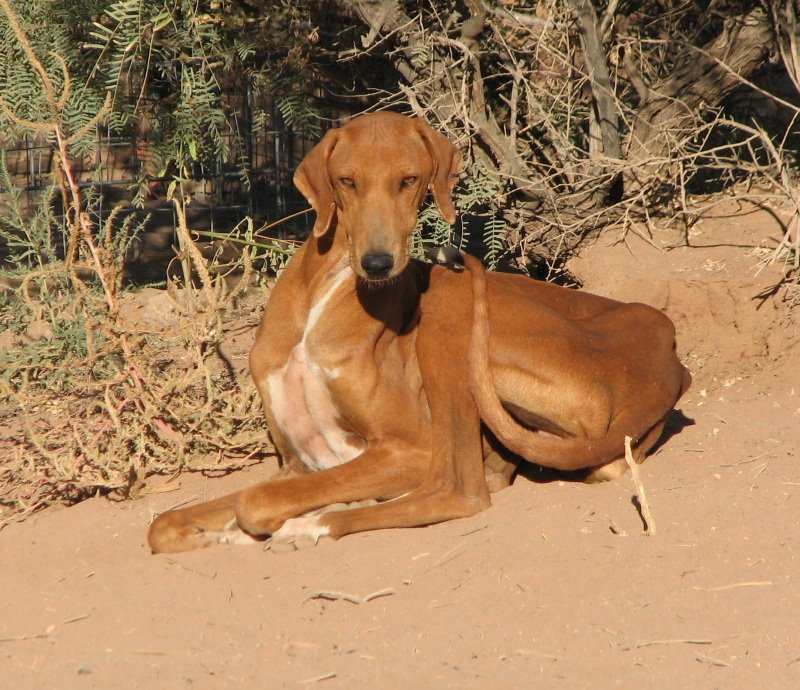
The head is moderately long and somewhat narrow, the skull moderately wide. The ears are pendant and flat; quite wide at the base and extremely mobile. There is great width between the eyes to optimize binocular vision. The eyes are obliquely set, large and almond-shaped with pigmented eyelids and range from dark brown to light amber in color. Teeth are strong and large with a scissor bite. The nose is pigmented.
NECK
The neck is straight, lithe and set high. The moderate length of the neck enhances the overall impression of a long-legged, short-backed dog.
FOREQUARTERS AND CHEST
The bones of the forelegs are attenuated and vertical, dense and bladed, with no hint of weakness. Withers are prominent, the ribs long and flat. There is conspicuous distance between the point of the elbow and the base of the chest, due to a very open scapular-humeral angle combined with a highly placed base to the chest. The sternum is short and rises abruptly at its distal point to a high tuck-up, giving a distinctive keel-shaped underline. These combined distinctions reinforce an overall impression of generalized elegance and loftiness.
HINDQUARTERS
Hipbones are quite prominent and the croup steeply sloped, an angle which mirrors the steep angle of the scapula joint. The stifles are open-angled and very high, the hocks set very low to the ground. The vertical alignment, when standing, of the hip joints and feet of the Azawakh—which gives an impression of sickle-hocks—is archetypal of animals well adapted to economical movement in a desert environment.
LOIN AND BACK
The topline descends from high iliac crests into the withers, giving the illusion that the hips are higher than the withers. The withers and hips are actually at the same height. The loin is short, lean and flat.
FEET
The feet tend to be cat-like, strong, of moderate size, and have obvious and high knuckles.
MOVEMENT
Movements are elastic, graceful and efficient, and are characterized by a feral quality which echoes the primitive origin of the dog. There is a freedom in the shoulders and hip-joints which allows for unimpeded forward motion. At a trot, the paws barely rise above the surface, without any excess lifting of the legs; the back feet fall directly beneath the center of the back, providing a lissome, balanced gait. The vertical format yields a very upright, double-suspension gallop.
COAT
Hair is short and fine and may be absent from the belly.
TAIL
The tail is thin, tapered and set low, extending to the point of the hock, and covered with the same type of hair as that of the body. The tail may be curled but a sickle-shaped tail is preferable.
COLORS
Any combination of colors and markings, including the absence of markings, is acceptable.
A New Standard
An open letter from Daoud Abdullah Abdullah to the world Azawakh community.
February 4, 2009
Dear Friends: I would like to explain in more detail why we have crafted a new and hopefully improved standard for the Azawakh—a standard that differs, in many ways fundamentally—from the document crafted by the authors of the Standard of the Azawakh accepted, presented and promoted by the Federation Cynologique Internationale (FCI).
Our motivation for crafting a new standard stemmed primarily from our belief that the FCI standard is (a) outdated and (b) fails to satisfactorily describe the Azawakh as it exists today and has existed historically in its homeland. France is the recognized patron country for the Azawakh by the FCI but there should be no confusion: Africa was the well-spring and both the ancestral and contemporary homeland of the Azawakh. All Azawakh, including specimens bred and raised outside Africa, are by default African dogs.
We feel lucky that in crafting the new standard we had the advantage—an advantage unavailable at the time of the crafting of the first standard—of basing part of our criterion upon the field research conducted be The Association Burkinabe Idi du Sahel (ABIS) of the dogs and peoples in the land of origin of the Azawakh: the Sahel zone of West Africa (as located in the modern countries of Mali, Burkina Faso, Niger and Southern Algeria).
Some history on the original crafting and later revisions to the first western-authored Azawakh standard is in order.
The first standard was authored by members of the Sloughi Club of France in the 1970s and based on only 7 aboriginal Azawakh that had been exported from the Sahel to France. It is now common knowledge that most if not all the dogs brought back to France (primarily by French civil servants returning to France when France lost political control of what was then French Colonial West Africa) came from the same general locale and that they were probably closely related, a supposition reflected in and supported by their relative homogeneity of morphology, color and markings.
For various reasons—some practical and some purely political—the authors of the standard were primarily preoccupied with delineating characteristics which would clearly differentiate, for FCI show ring judges, the Azawakh of the southern Sahara and Sahel from the Sloughi of North Africa and the Saluki type sighthounds of the Middle East. At the time of the introduction of the Azawakh to Europe, the Sloughi and Saluki were already recognized as distinct breeds and firmly established in western kennel clubs and registries. In fact, the Azawakh was originally considered a type of Sloughi called the Tuareg Sloughi while others argued that both the Sloughi and Azawakh were essentially smooth strains of Saluki. Revisions (for example the hallmark “keel-shaped underline” was changed to “rounded”) were introduced by politically-connected European Azawakh breeders to make the standard conform to the dogs bred by them.
We, and by accounts many others, believe that the FCI standard contains so many errors and omissions—partially a result of the sampling error caused by basing their criteria on only 7 dogs, combined with the contemporary political environment, as well as honest mistakes—that the continued sole adherence to its tenets endangers the future health and longevity of Azawakh bred in the west. To their credit, several Europeans breeders have tried to introduce corrections which would have improved the FCI standard, but their improvements were dismissed. Those breeders fought a hard battle and deserve our respect. They recognized that strict adherence to and judgment of the dogs based upon a dogmatic interpretation of an incorrect standard had caused and continues to cause an alteration of the breed in general; an insidious drifting further and further from the aboriginal African type. It has now reached a point where the resemblance of many western-bred Azawakh (dogs bred specifically to “win” in a show ring and thereby increase the pride, reputation and ego of their breeders) to the dogs of the Sahel is purely superficial.
But back to history…
Azawakh breeding outside of the Sahel was founded on only 13 aboriginal dogs exported from Africa to Europe in the 1970s and early 1980s. From the onset these dogs were “canonized” by what could be considered an elitist clique of Azawakh breeders and owners who considered only these 13 dogs “pure” and all other Sahelian-bred dogs—both specimens living in and outside Africa—to be “impure”. The result was a generalized disinclination for breeders to use anything other than the descendants of the original 13 Azawakh in their breeding programs. This result has proved quite unfortunate for the breed in the West.
Three separate “strains” or “lines” were established using those first 13 Azawakh: the French (founded on 7 specimens), the Yugoslavian (founded on 3 specimens-It bears noting that two of the three specimens were littermates) and the Coppé (founded on 3 specimens). The Coppé line was developed later than the French and Yugoslavian lines and could be considered an “out-cross” to the other lines. The Coppé line was really the beginning of a new wave of imports that ABIS continued. The Coppé line is included in the “canon” because of the fact that dogs of this line are now heavily integrated into western breeding programs. Other Sahelian imports of the late 1980s contemporary with the Coppé imports were less utilized, primarily because of the stigma of being somehow “impure”.
The intense line-breeding using mainly these 13 dogs led not only to a “type drift”, which is relatively easily corrected, but more unfortunately to some serious health problems in the western bred Azawakh. Most notably heritable idiopathic epilepsy nearly destroyed the Yugoslavian line until the breeding of these dogs “pure-in-the-strain” ended with the willingness of their breeders to introduce dogs from other lines into theirs. There is no longer a “pure” French or “pure” Yugoslavian line. Luckily all three lines have now been crossed together and several “New African” Sahelian-bred dogs have been introduced, thereby increasing the genetic base and options for future breeding.
AZCA strongly advocates support for the work of the aforementioned ABIS, the non-profit organization dedicated to studying and supporting the aboriginal dogs and the peoples who breed them in the Sahel. Again, we are grateful to ABIS for all their work on behalf of the Azawakh, and most specifically for importing the majority of the recently imported Sahelian-bred specimens. Since ABIS’s inception they have mounted 15 expeditions to the Sahel and the next and possibly final expedition leaves in February 2009. We hope that ABIS will find a way to continue to import desert bred specimens, as importation is becoming increasingly challenging (for example young puppies can no longer be exported directly from Africa to Europe because of overly-strict EU importation regulations). We also promote and encourage the intelligent integration of these dogs into the western gene pool as, again, we believe the type, health and longevity of the breed in the west is dependent upon continued and increasing integration of Sahelian-bred stock.
Unfortunately, the reality is that the integration by breeders of Sahelian-bred specimens is challenging if not extraordinarily difficult due primarily to the fact that the FCI standard does not satisfactorily conform to the dogs bred by the peoples in the Sahel, the correct and fortunately available source of aboriginal breeding stock.
As it has been extremely difficult to make the most minor and necessary improvements to the FCI standard, we decided that the best course was to craft a new standard: again, a standard based on extensive empirical observation of the dogs in Africa and interviews with their traditional breeders. The AZCA standard was crafted to allow for inclusion of as much phenotypic and by default genetic diversity as possible by delineating the range of typical specimens found in the Sahel as well as providing a hint of the cultural and environmental context for their unique characteristics.
We believe developing a new standard based on empirical research was the most constructive course of action. We encourage any and all to read and study our new Standard of the Azawakh. Interpretations will no doubt vary and it could be kept in mind that a standard be considered only one tool for increasing one’s understanding and appreciation of the dogs.
Therefore we ask that any standard be accorded its appropriate perspective as we, the friends of the Azawakh, in solidarity, move forward in our efforts to preserve this ancient and noble breed of dog.